Decide whether a project belongs in filament or resin
Choose a process by the finished object's requirements and the complete workspace it needs.
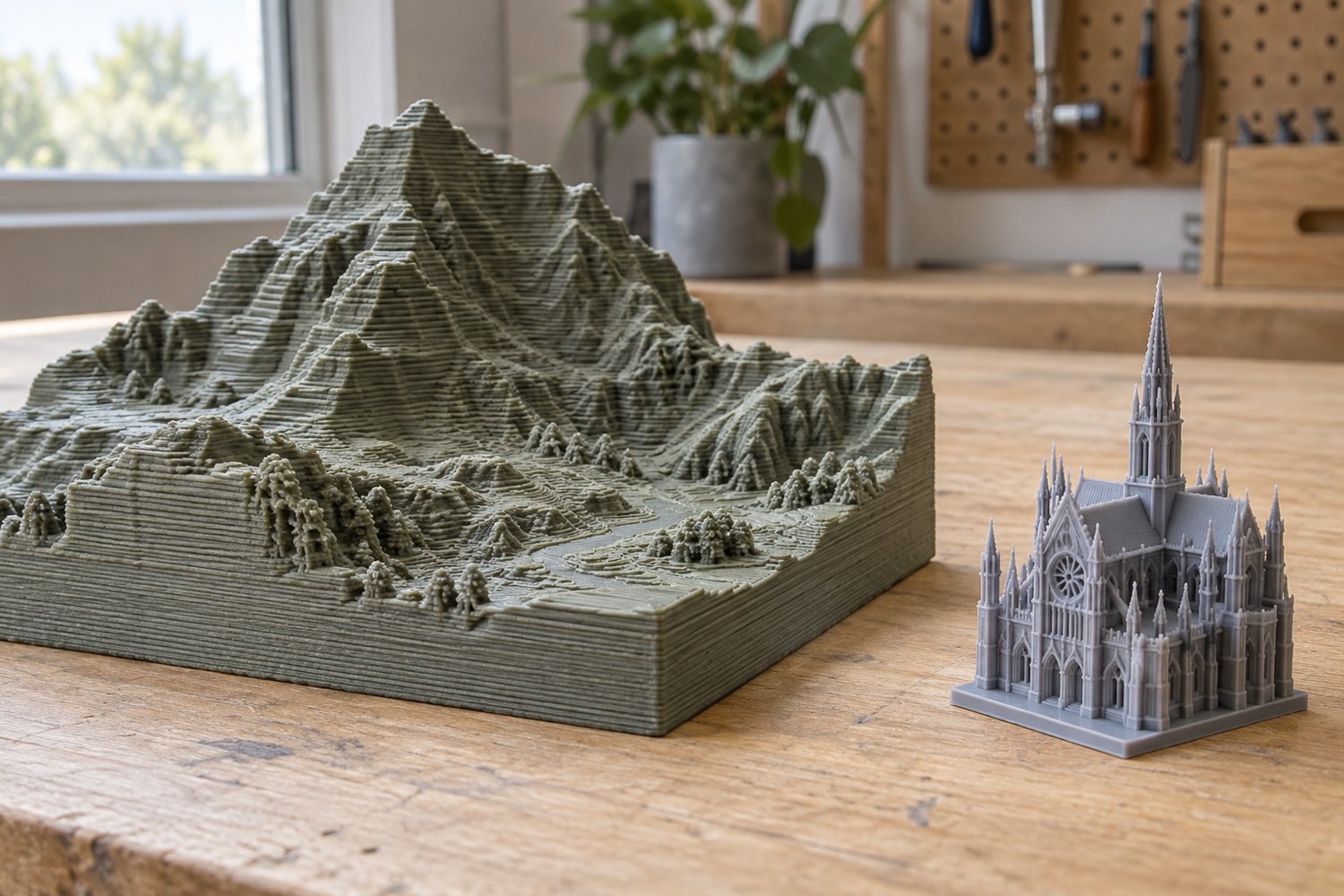
A tiny textured figure and a large terrain tray can both be described as 3D models, yet they make different demands on a printing process. Begin with the finished object: its dimensions, smallest important detail, handling conditions and planned finish. Then compare how filament and resin workflows would produce it, including the work after printing.
Filament printing builds with extruded material; resin printing forms parts from a light-reactive liquid using a compatible system. Neither description establishes the quality or suitability of a particular machine. Use representative examples and the exact material documentation rather than assuming every resin is interchangeable or every filament behaves like a familiar spool of PLA.
Decide what must survive the process
Mark the details that are essential and those that are merely attractive on screen. A thin railing must survive support removal and handling. A terrain tile must fit the other tiles. A display model may prioritise surface appearance, while a removable lid needs repeated assembly. These criteria are more useful than choosing a process solely because a photograph looks sharp.
Compare the full size of the project with the usable build area and the likely orientation. Include supports and access for removal. A smaller resin machine may require a landscape to be divided into more pieces; a filament approach may require some fine features to be redesigned. Those are project costs that should appear in the comparison from the beginning.
Count the whole workflow
For resin, plan printing, removal, washing, drying, curing and waste handling as connected tasks. The exact resin and equipment instructions govern the process. CDC guidance notes that resin printing can release particles and gases that a cover may not contain, and that skin and inhalation exposure need appropriate controls. A closed lid is not, by itself, a complete workspace plan.
For filament, consider material storage, machine operation, support cleanup and any sanding or painting. This process also requires suitable exposure controls and the manufacturer's operating conditions. Choosing filament does not mean that all materials are appropriate for an occupied room without further assessment.
Write down the equipment and space needed beyond the printer. Include compatible post-processing supplies, storage, cleanup materials and the route for waste. If the available room cannot support the complete workflow, a printing service can be a more workable choice than buying a machine first and improvising the rest later.
For a mixed scene, the processes need not compete for every component. A broad base and a small decorative element can be made separately if their scale and joints are planned. Obtain or make representative samples and examine them after the intended finish. Treat those samples as evidence about that setup, not a universal ranking. The appropriate choice is the process whose complete workflow produces the object you need within the space and handling arrangements you can actually provide.
For a first project, write two short production plans for the same object. Each should name the printer configuration, material, support strategy, finishing stages and storage requirements. Leave a blank wherever you cannot yet specify the next step. Those blanks are useful: they identify the questions to answer before purchase. A comparison that includes only the print stage can make one process appear simpler by leaving its unfinished work outside the frame.
If using a service, ask what material and post-processing are included and whether the supplied model needs changes. Request clarification about hollow parts, fragile details and assembly tolerances before ordering. The same project questions still apply; the difference is that the equipment and processing are handled elsewhere.
Another detail to explore
Choose a first 3D printer around the objects you want to make
Start with three objects, their dimensions and the space available for making them. Those decisions narrow the printer search before speed claims do.
Read article
Read a sliced preview before starting a print
Read the toolpaths, first layer and delicate features before a file reaches the printer.
Read article